
saw
Makita SP6000J 6-1/2-Inch Plunge Circular Saw
corded · On-rail depth not confirmed
Check the exact package, regional version and seller terms at Amazon.
Check Amazon offerThe saw · The rail · The complete setup
A track saw is a rail-guided cutting system, so choose the cut and rail requirements before the brand. Compare exact saws, package contents, blades and support for your material, power source and workspace.
As an Amazon Associate I earn from qualifying purchases. How affiliate links work.
These are starting points across documented corded options, not a hands-on performance ranking. Compare the exact packages and current offers.
saw
corded · On-rail depth not confirmed
Check the exact package, regional version and seller terms at Amazon.
Check Amazon offer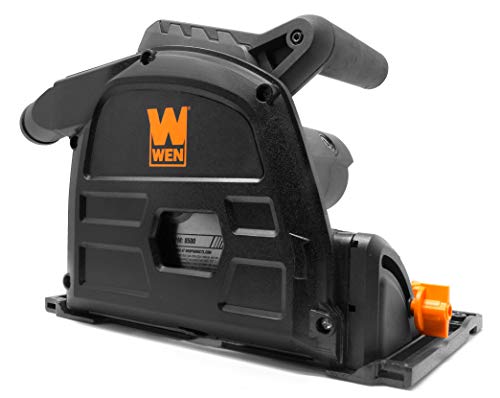
saw
corded · 54 mm on-rail depth at 90°
Check the exact package, regional version and seller terms at Amazon.
Check Amazon offer
saw
corded · 51 mm on-rail depth at 90°
Check the exact package, regional version and seller terms at Amazon.
Check Amazon offerA track saw follows a guide rail to make straight cuts in supported material. A plunge model lets the blade move down through its base, while some rail-compatible circular saws use a different cutting mechanism. Guide adapters can also help an existing circular saw follow a rail, but they do not turn it into the same machine.
The distinction matters when you compare cutting depth, bevel operation, dust collection and the way a cut begins. A saw’s bare-base depth can exceed its capacity while sitting on a rail. The blade diameter alone does not tell you whether a specific board fits.
For sheet goods, the practical advantage is moving the saw along a supported panel instead of moving the entire panel past a stationary blade. For repeated narrow rips or other operations, a table saw may remain the more suitable part of the workflow. Choose from the tasks, not a promise that one tool replaces everything.
Read the cutting and technique guidesAs an Amazon Associate I earn from qualifying purchases. How affiliate links work.
| Documented specification | Makita SP6000J | WEN CT1065 | Festool TS 55 FEQ |
|---|---|---|---|
| Power | corded | corded | corded |
| Blade diameter (mm) | 165 | 165 | 160 |
| Arbor (mm) | 20 | 20 | 20 |
| 90° depth on rail (mm) | Not confirmed | 54 | 51 |
| 45° depth on rail (mm) | Not confirmed | 38 | Not confirmed |
| Rail system | Makita plunge-saw rail | WEN CT9502 | Festool FS |
| Battery platform | Not confirmed | Not confirmed | Not confirmed |
| Matched Amazon offer | Check Amazon offer | Check Amazon offer | Check Amazon offer |
Capacities are model-specific and refer to rail use where documentation confirms it. Unknown values stay unconfirmed. Check the source guide for blade, material and setup restrictions.
A cordless system to compare
The Milwaukee plunge track saw belongs on your shortlist alongside the rail, blade and complete kit cost. Battery ownership is one part of the decision; confirm the supplied pack, charger and rail before assuming a listing completes your setup.
As an Amazon Associate I earn from qualifying purchases. How affiliate links work.
Read the exact Milwaukee 2831 evidence
Check Amazon offer
Use the actual material thickness and intended cut angle. Check both square and bevel capacity in the exact manual, including any blade or scoring limitations.
Corded machines need an appropriate supply and a managed cord path. Cordless models need the correct battery platform, pack combination and charging plan.
A saw sliding along a rail is not proof that bevel retention, anti-kickback features, clamps and accessories work together. Check each function and model combination.
Match the documented diameter, arbor, kerf, body thickness, speed rating and blade type. Similar-looking blades and different generations of the same saw can have different requirements.
Plan sheet support, offcuts, dust handling and enough rail length for entry and exit. Add clamps, connectors and batteries only after checking what your chosen kit contains.
comparisons
Compare track saws and table saws for plywood, narrow strips and repeat cuts. Choose your first saw around the work you actually need to do.
comparisons
See where a dedicated track saw improves sheet cutting and where a circular saw with a guide still makes sense for your projects and budget.
comparisons
Choose between a track saw and miter saw for panels, trim, angled cuts and repeated lengths, with practical limits for each workshop setup.
comparisons
Compare track saws with vertical panel saws for sheet handling, workshop space, repeated sizing and the cost of a complete cutting workflow.
comparisons
Understand track guidance versus plunge action, which features overlap, and why adding a guide does not turn every circular saw into a plunge saw.
comparisons
Compare a track saw and jigsaw for long straight cuts, curves, openings and finished edges, with practical advice for choosing complementary tools.
comparisons
Compare a dedicated track saw with Kreg Accu-Cut and Rip-Cut attachments. Understand straight references, repeat widths and compatibility limits.
comparisons
Decide between corded and cordless track saws by power access, batteries, extraction, storage and total system cost instead of voltage alone.
comparisons
Compare Makita SP6000J and Festool TS 55 FEQ for a corded panel-cutting setup, including rails, existing accessories and what justifies an upgrade.
Answers to questions observed in Google’s People Also Ask panels, with links to detailed guidance. Related wording shares a guide when it asks the same underlying question.
A track saw follows a guide rail for controlled straight cuts, commonly in sheet goods and larger supported workpieces. Dedicated plunge models and rail-compatible circular saws have different mechanisms; choose the exact system for the operation. Read the detailed guide.
A purpose-built guide adapter can help a compatible circular saw follow a rail. It does not add the plunge mechanism, enclosed blade housing or every capability of a dedicated track saw. Verify the adapter and saw combination. Read the detailed guide.
A track saw is useful for bringing a guided cut to a supported sheet or large workpiece. A table saw suits other workflows, including repeated ripping with appropriate support. Neither automatically replaces the other for every operation. Read the detailed guide.
Value depends on how often you make the cuts the system serves and what equipment you already own. Compare the saw plus rails, batteries, blades, support and dust handling. A low saw-only price may not be the lowest complete-system cost. Read the detailed guide.
A track saw requires careful sheet support, rail placement and accessory selection. Repeated narrow rips and some joinery tasks may suit another tool better, while long rails take storage space. It is one part of a workflow, not a universal replacement. Read the detailed guide.
For occasional straight cuts, a compatible circular saw and rigid guide may be enough. Repeated narrow rips can favor a table saw, while crosscut-heavy trim work may favor a miter saw. Choose the operation before the substitute. Read the detailed guide.
Keep a circular saw when general cutting and occasional guided cuts dominate. Consider a dedicated track saw when rail-guided panel cuts and controlled plunges recur often enough to justify the saw, rail and extraction system. Read the detailed guide.
The Harbor Freight results inspected for this build showed cutting guides and related accessories, but did not establish an exact dedicated plunge track-saw model. A guide or a track-saw blade is not the saw itself; check current retailer listings before assuming availability. Read the detailed guide.
The purchase often includes more than a motor: a guided base, plunge mechanism, rails, compatible blades, extraction parts and sometimes batteries. Compare the complete first-cut package; a premium price is worthwhile only when those features solve recurring work. Read the detailed guide.
Many track saws make bevel cuts, but the available angle and cutting depth are model-specific. Check the depth on the rail at 45 degrees, the rail retention requirements and the exact manual rather than using the square-cut capacity. Read the detailed guide.
Best value is the lowest complete system that meets your documented on-rail depth, rail-length, blade and power requirements. A cheaper bare saw can cost more after the missing rail, battery, charger or suitable blade is added. Read the detailed guide.
Not as a general rule. Verify the exact saw-and-rail pair, including base adjustment, bevel retention, anti-kickback behavior and approved accessories. Sliding onto the extrusion proves only physical fit. Read the detailed guide.
Milwaukee documents its saw with named Milwaukee rails. A third-party compatibility claim should be checked for the exact rail, saw generation and retained functions; apparent fit does not establish manufacturer approval. Read the detailed guide.
No universal rail standard covers every saw and feature. Profiles can look similar while clamps, connectors, bevel support, adjustment cams or anti-kickback functions differ. Read the detailed guide.
Start with the DEWALT rails named for the exact DWS520, DCS520 or DCS525 documentation. Treat third-party listings as leads until the precise saw, rail length, profile and functional support are verified. Read the detailed guide.
Do not treat them as the same system. Confirm each exact saw-and-rail pairing and every needed function; similar profiles or third-party fit claims do not prove identical adjustment, bevel or accessory behavior. Read the detailed guide.
Some adapter systems accept a range of circular saw shoes, but that is not a universal plunge-saw rail. Verify the adapter’s shoe limits, guard clearance, usable depth and approved operation for the exact saw. Read the detailed guide.
Milwaukee’s documented rail family is the supported starting point. For another brand or third-party rail, require exact evidence for base fit, adjustment, bevel retention and any anti-kickback interaction before assigning compatibility. Read the detailed guide.
No brand wins every workflow. Compare the exact models that satisfy your cut, then use batteries, rail accessories, blade supply, service route and complete package cost as tie-breakers. Read the detailed guide.
Do not infer approval from a physical slide test or a seller claim. Check the exact Milwaukee saw and Festool rail pairing for adjustment, bevel retention, anti-kickback behavior and accessory conflicts; otherwise use the documented rail family. Read the detailed guide.
For long straight cuts in a supported full sheet, a track saw is often practical because the saw travels across the panel. Repeated narrow rips or small parts may fit a different machine better; support and blade choice still decide the result. Read the detailed guide.
Support the full sheet and both future pieces, mark the retained side, choose a suitable blade and use a rail long enough for the cut plus required entry and exit travel. Plan hose and offcut movement before starting. Read the detailed guide.
A track saw suits portable straight sheet cuts; a table saw can suit repeated rips when the panel can be supported and controlled; a circular saw with a guide may cover occasional work. Choose from the cut sequence and workspace. Read the detailed guide.
Shortlist models with documented on-rail capacity for the sheet and bevel, then compare rail length, a plywood-appropriate blade, extraction and package completeness. Brand alone does not establish the finished edge. Read the detailed guide.
Festool belongs on a shortlist when its exact saw generation, rail accessories and documented features fit repeated work. It is not automatically best for a buyer whose capacity, battery platform, package or budget points elsewhere. Read the detailed guide.
There is no durable best price because packages and listings change. Compare current quotes only after matching the saw, rail, power equipment, blade and support needed for your first real cut. Read the detailed guide.
Compare exact models rather than brands. DEWALT DCS520, newer DCS525 and Milwaukee 2831 differ in power platform and system details. Existing batteries, supported rails, required depth and complete package costs should guide the choice. Read the detailed guide.
It can be worthwhile when guided sheet or long-workpiece cuts recur and the system removes a real handling or setup problem. Compare that benefit with rental or a suitable guide for a circular saw before buying the full system. Read the detailed guide.
There is no universal brand winner. Compare the exact regional Mafell and Festool models, required capacity, rail and accessory workflow, package contents and service route. The documented MT 55 cc and TS 60 KEB comparison separates those decisions without claiming a hands-on winner. Read the detailed guide.
Manufacturer documentation establishes particular functions and accessories, not a universal quality or durability verdict. Judge the exact model by whether those documented functions, regional support and complete system match the work. Read the detailed guide.
There is no single best track saw for every workshop. Compare documented on-rail capacity, power platform, rail system, blade requirements, service path and complete setup cost for the work you actually do. Read the detailed guide.
Do not assume one permanent price or that premium positioning proves value. Compare current quotes for the exact regional saw and the complete rail, blade, power, extraction and service setup, then decide whether its documented functions solve a recurring need. Read the detailed guide.
John Morris publishes TrackSaw.net as an independent specification-based resource. We use manufacturer pages and manuals, distinguish exact models and preserve uncertain information. We do not claim to have physically tested these saws, and we do not publish invented review scores or live prices.
A useful recommendation explains the tradeoff and lets you inspect the source. Start with the model documentation, then verify the actual listing and package before buying. Read our research method and affiliate disclosure.