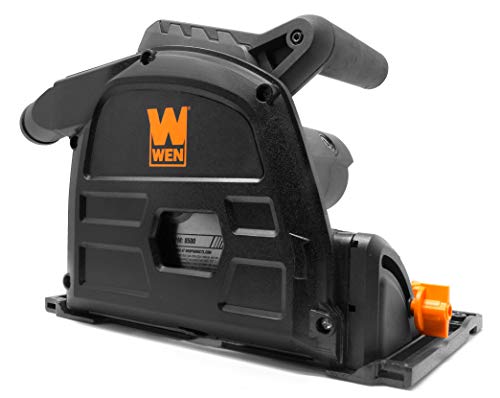
Track Saw Comparisons
Track Saw vs Plunge Saw: What Is the Difference?
Track saw describes how a saw follows a guide; plunge saw describes how its blade enters the workpiece. Many dedicated woodworking track saws are also plunge saws, so the terms frequently refer to the same machine. The distinction matters when comparing a purpose-built saw with a circular-saw guide attachment. This guide separates the functions using manufacturer descriptions, without claiming hands-on testing.
As an Amazon Associate I earn from qualifying purchases. How affiliate links work.
Inspect the relevant offer

Makita SP6000J 6-1/2-Inch Plunge Circular Saw
Check Amazon offerGuidance and blade entry answer different questions
A guide rail establishes a straight path across the workpiece. A compatible saw rides along that path with the intended base and adjustment system. Plunge action allows the blade assembly to lower into the material through the saw’s designed mechanism. These are related features, but one does not prove the presence of the other.
For a buyer, the useful questions are whether the saw fits the intended rail and whether its manual permits the requested cut. A retailer using track and plunge interchangeably may be describing a legitimate combined tool, but check the model number rather than relying on the category name.
Why a circular-saw sled is different
A guide attachment can provide a straighter reference for an existing circular saw. It does not replace the saw’s guard, depth controls or operating instructions. Kreg distinguishes its Accu-Cut circular-saw guide from its Adaptive Cutting System plunge saw; the products are not interchangeable simply because both guide cuts.
This distinction can save an expensive compatibility mistake. Buy an attachment for the saw you actually own, and do not assume the dedicated plunge saw will fit every rail sold by the same brand. Product families can use separate arrangements.
An interior opening needs more than the right name
A plunge-capable saw may be used for documented interior-cut operations, but the exact setup requires the manufacturer’s procedure. Start and stop positions depend on blade geometry and depth, not just the visible top cut line. A circular blade cannot create a perfectly square internal corner by extending every pass without consequence.
Plan how corners will be completed with an appropriate tool, and keep both the main workpiece and cutout supported. Do not improvise guard restraint or reverse-feed techniques because a video uses the word plunge. The actual manual governs the operation.
Rail length and blade depth remain separate limits
A longer guide helps span a longer straight cut. It does not increase how deeply the blade reaches. Conversely, a deeper-cutting saw still requires adequate guide engagement before and after the material where the manufacturer specifies it.
When comparing listings, record on-rail depth at the intended angle, rail family and included rail length. If a quoted cutting depth does not identify the rail condition, leave it unresolved until the manufacturer clarifies it. Mixing on-rail and off-rail figures produces a misleading comparison.
Use the distinction to choose a system
For repeated panel work, a dedicated plunge track saw offers an integrated combination to evaluate. For occasional straight cuts with an existing circular saw, a compatible guide may meet the need without a second motor. Neither category promises a particular finish without appropriate blades, support and setup.
The purchase decision becomes simpler when written as an operation: for example, straight sizing of supported plywood or a manufacturer-permitted interior cut in a worktop. Then check the documented tool, rail, blade and support requirements. Buy the arrangement that meets that operation rather than paying for terminology.
Questions about Track Saw vs Plunge Saw: What Is the Difference
Are all track saws plunge saws?
Do not assume so. Track describes guidance, while plunge describes blade-entry action. Check the exact machine and manual.
Can a plunge saw cut without a track?
Some models permit certain off-rail operations. That must be confirmed in the model instructions; guidance and safety features may depend on the rail.
Is a plunge saw better than a track saw?
The categories overlap. Compare the actual saws and operations rather than treating these names as two separate performance tiers.