Track Saw Questions & Technique
Track-Saw Dust Collection: Build a Working Setup
Good track-saw dust collection requires a working system, not merely a hose pushed onto a port. The connection must fit, the extractor must suit the dust and the hose must move without disturbing the saw or rail. A manufacturer's collection claim does not establish the exposure conditions in your particular workshop.
As an Amazon Associate I earn from qualifying purchases. How affiliate links work.
Inspect the relevant offer
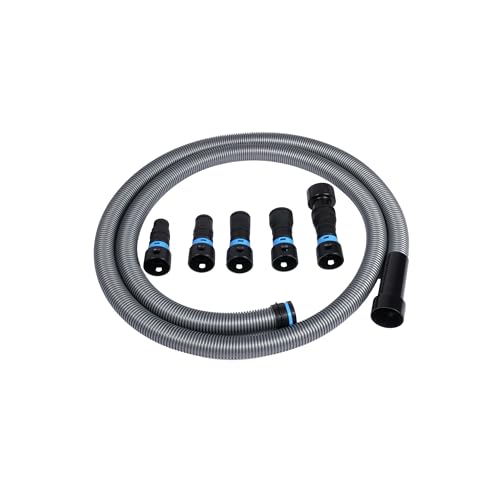
Cen-Tec Systems 94698 Quick Click 10 Ft. Hose for Home and Shop Vacuums with Expanded Multi-Brand Power Tool Adapter Set for Dust Collection
Check Amazon offerBegin with the material and its dust
Identify whether you are cutting plain wood, MDF, a coated board or another approved material. Consult the material information as well as the saw instructions for required controls. Different dusts and chips may require different handling; do not carry a wood-dust setup into an approved metal-cutting job without reviewing the extraction restrictions. The question is not just how much visible debris reaches the floor. Fine airborne material and the cleanup process also belong in the plan.
Confirm the actual connection dimensions
A nominal hose size does not always describe the surface that mates with the saw. Check whether the connection is intended to fit inside or over the port and whether an adapter is specified. A stepped universal adapter may physically connect while creating an awkward restriction or a protrusion that catches during travel. Prefer documented fit where available. With power disconnected, check that the connection stays secure without interfering with the saw's controls, plunge movement or guide engagement.
Match the extractor to the job
Consider the manufacturer's requirements for the saw and material, including suitable filtration and collection accessories. A shop vacuum with an unsuitable filter is not automatically adequate because it has a strong suction claim. Check bag and filter installation, condition and capacity before a session. If the unit offers automatic tool activation, confirm compatibility with the saw's power arrangement and the extractor's instructions. Cordless saws and corded auto-start outlets may need different control methods rather than an assumed plug-and-play connection.
Plan the hose like a moving guide
A hose can pull a lightly held rail sideways or catch on a connector near the end of a cut. Give it enough reach and a clear route that avoids the blade path and your footing. Test the complete disconnected travel before working on a valuable panel. A support boom or compatible hose guide may help in a fixed shop, but it should not introduce tension that lifts the saw connection. The useful test is smooth travel over the entire real cut, not only at the starting position.
Troubleshoot losses in a sensible order
If collection worsens, stop and disconnect equipment before checking for a full container, loaded filter, loose adapter or blockage. Inspect the saw's collection path only as the manual permits. Compare performance with the same material and setup so the observation is meaningful. A blade change or a cut near a panel edge can alter how chips escape, so avoid blaming the extractor immediately. Document when the problem happens and correct one variable at a time rather than buying successively larger hoses without diagnosis.
Make cleanup part of the cutting workflow
Collect settled dust with an appropriate method instead of redistributing it through the shop. Maintain the extractor according to its instructions and inspect the hose for damage before storage. Keep rail contact surfaces clear so dust does not compromise grip on the next job. Protective equipment and ventilation decisions should follow the actual material and workspace requirements; a clean-looking saw housing is not a substitute. The best setup is one you can connect, use and maintain consistently for the work you actually perform.
Questions about Track-Saw Dust Collection: Build a Working Setup
Will a track saw collect all its dust?
No general promise is reliable. Collection depends on the saw, material, blade, extractor and setup. Treat advertised percentages as manufacturer claims under their conditions, not measurements of your workspace.
Can I use a shop vacuum with a track saw?
Possibly, if the saw, vacuum, connection and filtration are appropriate for the material and instructions. Physical hose fit alone does not establish that the complete system is suitable.
Why does my hose move the rail?
It may be too short, poorly routed, caught on an obstruction or connected through a rigid adapter. Rework the route and secure the rail as the system instructions require.


