Track Saw Care & Setup
How to Clean and Store Track-Saw Rails
Track-saw rails are measuring references as well as guides. Dirt can affect grip and travel, while careless storage can damage a long extrusion. Clean each surface according to its function and the manufacturer's instructions. A maintenance routine should preserve the rail's geometry and calibrated edge, not simply make the aluminum look polished.
As an Amazon Associate I earn from qualifying purchases. How affiliate links work.
Inspect the relevant offer
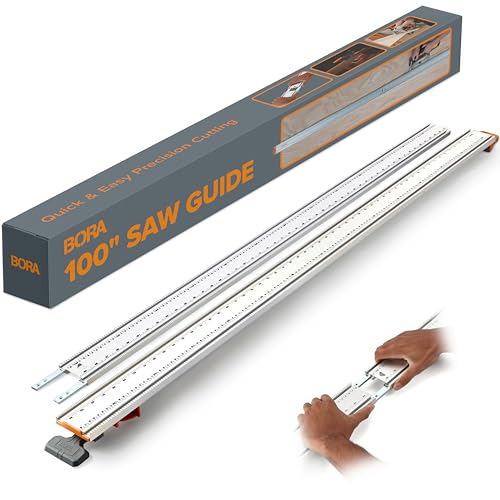
BORA NGX Circular Saw Guide Rail, 100" Straight Edge Clamp - Track Saw Rail
Check Amazon offerSeparate grip from glide
The underside contact pads help the rail stay on the work, while upper running surfaces help the saw move along it. The blade-side strip provides another function again. A lubricant intended to reduce drag on top should not be assumed suitable for the grip pads underneath. Use only the maintenance products and methods approved for the rail. If the saw feels difficult to push, first identify dirt, adjustment or damage rather than treating every surface with the same spray.
Clean after dusty panel work
After the blade stops and the tool is disconnected, remove debris through the permitted cleaning method. Inspect the guide channel, rail ends and connector area, where small chips can alter fit. MDF and other dusty materials make it especially useful to clean before placing the rail on the next finished panel. Avoid dragging a contaminated underside across a decorative surface. A quick inspection can prevent a scratch that has nothing to do with the quality of the actual saw cut.
Watch the consumable strips
Look for peeling grip pads, worn running strips and a damaged splinter edge. Identify the correct replacement component for the exact rail rather than treating all adhesive strips as equivalent. A loose end can catch the saw or change contact with the work. Follow the maker's removal, surface preparation and installation guidance. If a strip repeatedly comes loose, investigate contamination or storage conditions instead of repeatedly adding adhesive that may make the next proper repair harder.
Protect connectors and reference ends
Remove or store connecting hardware as directed so it does not bend, collect debris or damage the rail during transport. Keep compatible sets together and label them if several rail systems share the shop. Before joining rails again, inspect the mating areas and follow the alignment procedure. A connector that feels tight does not prove the guide is straight. The maintenance goal is to preserve a repeatable assembly process, including the small parts that are easy to lose or substitute incorrectly.
Store long rails without abuse
Choose a storage arrangement that supports and protects the rail according to the manufacturer's guidance. Avoid locations where heavy stock is piled against it, vehicles strike it or a door repeatedly hits an exposed end. A transport bag protects surfaces but is not proof against bending. Think about the route from storage to the cutting area as well as the rack itself. A shorter connected system may suit a mobile workspace better than a long rail that cannot be carried and stored carefully.
Inspect after a drop or impact
If a rail is dropped, bent or struck, check its guide surfaces, strips and straightness before cutting valuable material. Do not assume a new splinter strip repairs damage to the extrusion. With power disconnected and the blade retracted, verify permitted saw travel, then use an appropriate test setup only after the system is judged serviceable. Consult the manufacturer when damage is uncertain. Trying to compensate for a damaged rail by altering the saw's guide fit can transfer the problem into every future cut.
Questions about How to Clean and Store Track-Saw Rails
Should I oil my track-saw rail?
Use only the manufacturer's approved maintenance method for the relevant surface. Oil on grip pads or the workpiece can create problems, and lubrication is not a repair for damage or misalignment.
Can I hang a long rail on the wall?
Use a support arrangement suitable for that rail and protect it from impacts and distortion. Follow the manufacturer's storage guidance rather than assuming any two hooks provide adequate support.
How often should I replace rail strips?
Inspect condition and function rather than using a universal calendar interval. Replace the correct component when wear, peeling or lost calibration prevents it from working as intended.


