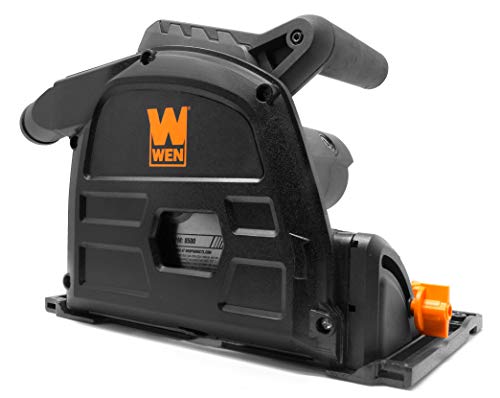
Track Saw Comparisons
Can a Track Saw Replace a Jointer for Straight Edges?
A track saw can establish a straight sawn edge on suitable, properly supported material. It does not perform the face-flattening function of a jointer or make board faces parallel like a thickness planer. Whether its edge is suitable for the next joint depends on the result and project. This explanation compares functions; it is not a claim of hands-on glue-joint testing.
As an Amazon Associate I earn from qualifying purchases. How affiliate links work.
Inspect the relevant offer

Makita SP6000J 6-1/2-Inch Plunge Circular Saw
Check Amazon offerA straight line is only one part of milling
A rail gives the saw a straight cutting reference. That can help remove an irregular edge when the board is held and supported in a manufacturer-approved arrangement. A jointer addresses a different reference-making task by machining a face or edge using its tables and cutterhead.
If the board is twisted or rocking, drawing a straight line along it does not solve the unstable face beneath the rail. The support problem must be resolved rather than hidden by holding the rail harder. Do not infer that every rough board is ready for track-saw edge preparation.
The face still needs to be usable
A board with an unsuitable face may not sit consistently on the working surface. That affects both control and the relationship of the cut edge to the face. The saw does not flatten that face simply by cutting along one side.
This is why a track saw cannot be described as a complete replacement for a jointer in rough-lumber preparation. It may perform a useful straight-edge operation within a larger process, but the remaining face and thickness requirements still need an appropriate method.
A glue-ready edge is an outcome to check
Do not assume that a sawn edge is always ready for glue, or that it is never suitable. Blade condition, alignment, material and the intended joint influence the result. Inspect the mating edges and use the requirements of the project to decide whether further preparation is necessary.
A straight-looking top line does not prove the entire edge is square to the reference face. If a panel joint needs consistent contact, check that actual contact rather than trusting a category label. Avoid using clamping force as a substitute for properly prepared mating surfaces.
A planer and router answer other questions
A thickness planer is not interchangeable with a track saw: it addresses thickness and the relationship to its reference support. A router can perform certain guided edge operations with appropriate tooling, but it is also not automatically a replacement for a saw or jointer.
Treat searches such as track saw versus planer or track saw versus router as questions about the next operation. State the desired result first: straight edge, flat face, parallel thickness, profile or groove. Then select an approved process for that result.
When the track-saw approach is useful
A builder working with stable, suitably surfaced boards may find a track-guided straight cut useful before further processing. A shop regularly preparing rough lumber should evaluate the complete milling sequence instead of buying a track saw under the impression it performs every jointing function.
Check the saw manual for permitted material dimensions and support. Long, narrow or irregular stock can create special holding problems. If the rail cannot be supported and the piece held correctly, use another suitable process. The useful claim is that a track saw can create certain straight edges, not that it turns every rough board into square, flat, dimensioned lumber.
If repeated rough-lumber preparation is the missing part of your shop, compare benchtop jointers by stock width and support before spending more on a saw system. Check the complete board dimensions and the subsequent thicknessing method; the purpose is to fill the gap in the milling sequence, not to buy two tools for the same straight cut.
Questions about Can a Track Saw Replace a Jointer for Straight Edges
Can a track saw joint an edge?
It can create a straight sawn edge in a suitable supported setup. Whether that edge meets a glue-up or square-edge requirement must be checked.
Can a track saw flatten a board face?
No. A straight saw cut along an edge does not perform face jointing or remove twist across the broad face.
Do I still need a planer?
If the project requires thickness preparation, that operation still needs an appropriate method. A track saw does not replace thickness planing.