Track Saw Questions & Technique
Can You Use a Track Saw Without a Track?
Some track saws permit operation without their guide rail; others are intended for a particular track system. The answer belongs to the exact model, not the category name. Even when off-rail use is allowed, the saw no longer has the rail controlling direction, and depth references and work support need to be reconsidered.
As an Amazon Associate I earn from qualifying purchases. How affiliate links work.
Inspect the relevant offer

Makita SP6000J 6-1/2-Inch Plunge Circular Saw
Check Amazon offerPermission comes before convenience
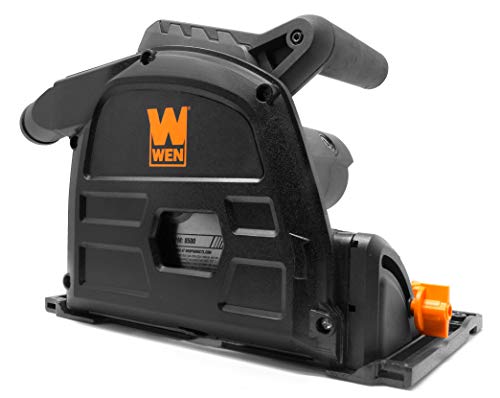
Start in the operating manual's intended-use and cutting sections. Look for explicit off-rail instructions, base sighting marks and depth guidance. A flat-looking sole does not prove that a manufacturer approves unguided operation. WEN describes the CT1065 as usable independently as a plunge saw, while Kreg presents its ACS saw as designed for its guide track. Those are product-specific statements. If the documentation is unclear, ask the manufacturer rather than applying a demonstration from a different brand.
What changes when the guide disappears
On a rail, the base follows a defined path and the trimmed strip marks a known edge of the kerf. Off the rail, you must guide the saw using the method the manufacturer permits. The base sits at a different height relative to the work. The support footprint and the position of the blade relative to your layout marks may also feel different. These changes mean that a successful on-rail setting should not simply be carried into an off-rail cut without checking it.
Identify the actual reason for removing it
A rail may seem inconvenient for a small job, but consider whether the workpiece is too small to support the saw safely in either arrangement. Removing the track does not solve poor workholding. If your reason is a rail that is too short, a longer compatible rail may preserve the guided workflow you bought the tool for. If the goal is occasional rough framing cuts, a conventional circular saw may be better suited to that work than adapting a precision panel setup.
A straightedge is a different reference
Where the saw manual permits a straightedge guide, its offset to the blade must be measured for that setup. Do not align the straightedge directly on a finished cut line unless the verified offset is actually zero. Consider both ends of the intended cut and mark the retained side. A clamp-on straightedge and a fitted track are not interchangeable accessories merely because both look straight. Their interaction with the saw base, guards and clamps must be assessed separately before cutting.
Preserve stability through the entire cut
An off-rail cut still requires a stable platform, controlled offcut and clearance below the work. Check what portion of the base remains supported at the finish, especially when trimming a thin strip. Avoid a setup that leaves you balancing the saw over the waste or reaching across its path. A small change in workpiece orientation can make a better layout; if you cannot maintain the manufacturer's required grip and control, choose a different method rather than compensating with one hand.
Decide by the required result
For a rough dimension with a generous finishing allowance, an approved off-rail method may be sufficient. For a visible cabinet edge or a long finished joint, the track's repeatable guidance is usually central to the appeal of the tool. Test the exact alternative arrangement on scrap and evaluate width, straightness and squareness separately. Saving a minute of rail setup is not useful if the result requires another machining operation or leaves too little material for the final dimension.
Questions about Can You Use a Track Saw Without a Track
Will the depth setting change without the rail?
It can. Some saws provide separate on-rail and off-rail indicators. Use the specific manual and confirm actual depth with power disconnected before making a trial cut.
Does every plunge saw work without a guide?
No category-wide assumption is reliable. Check the model's intended use and operating instructions; a saw designed for a particular cutting system may have different requirements.
Is a track saw without its track just a circular saw?
Both use circular blades, but mechanisms, guards, bases and permitted operations differ. Judge the exact tool rather than treating the two as identical after removing the rail.