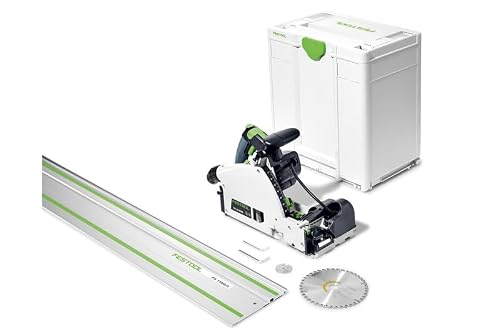
Track Saw Models
Festool TSV 60 K: Is a Scoring Track Saw Worth Buying?
The Festool TSV 60 K is a specialized buying decision: you are paying for a plunge-saw system with a separate scoring function. That makes it especially relevant to work where visible panel faces and reduced edge rework matter. It is not automatically the correct upgrade for everyone who cuts plywood. This guide examines the purchasing logic without claiming our own chip-out test or a guaranteed finish.
As an Amazon Associate I earn from qualifying purchases. How affiliate links work.
Inspect the relevant offer

Festool 576735 Plunge-Cut Saw with Scoring Function TSV 60 KEB-F-Plus
Check Amazon offerPackage checklist: what is actually included
As an Amazon Associate I earn from qualifying purchases. How affiliate links work.
| Exact package | Manufacturer-listed contents | Guide rail | Still needed before the first cut | Choose it when | Retained offer |
|---|---|---|---|---|---|
| TSV 60 KEBQ-F-Plus (576735) | Corded scoring saw, 168 x 1.8 x 20mm WD42 main blade, 47 x 2.5 x 6.35mm scoring blade, sight window, two keys and Systainer | No guide rail is listed in the Plus package contents; Festool documents FS and FSK compatibility | Chosen guide, support, extraction and a scoring-consumable plan | A repeated finished-panel workflow justifies the separate scoring operation | Check Amazon offer |
| Retailer 75-inch rail bundle | TSV 60 saw package plus the exact rail named by the retained verified offer | 75-inch rail listed by the retained offer | Support, extraction and scoring consumables suited to the material | The included rail covers the recurring finished-panel cut length | Check Amazon offer |
Festool TSV 60 K: documented specifications
| Documented specification | Festool TSV 60 K |
|---|---|
| Power | corded |
| Blade diameter (mm) | 168 |
| Arbor (mm) | 20 |
| 90° depth on rail (mm) | 57 |
| 45° depth on rail (mm) | Not confirmed |
| Rail system | Festool FS / FSK |
| Battery platform | Not confirmed |
| Matched Amazon offer | Check Amazon offer |
- Main blade 168mm; separate scorer 47mm.
- Current Festool manual documents57mm at90 degrees with FS guide rail;45-degree guided depth remains unknown.
- Official application copy says60mm while the technical table and manual state62mm general maximum.
A separate scorer is the central distinction
Festool identifies the US TSV 60 KEB-F-Plus as a plunge-cut saw with scoring function. Its manufacturer catalog lists a 168mm main blade and a 47mm scoring blade. This is different from merely fitting a finer-tooth main blade to an ordinary track saw.
Treat that additional mechanism as the reason for the purchase. Ask which recurring materials and visible edges justify it. If every panel edge is later trimmed, covered or machined, the economic argument may be weaker than it is for finished, exposed panels leaving the cutting station.
Translate reduced rework into a buying question
Start with a recent project and identify the edges that required repair or an extra finishing pass. Separate cutting defects from layout mistakes, damaged sheet material and errors in the next machining step. A scoring saw should not be credited with solving problems that originate elsewhere.
Then consider how often those cuts recur. A cabinet business processing delicate finished panels may evaluate saved handling differently from a hobbyist making an occasional plywood shelf. Use your own time and material costs; an arbitrary claim that the saw pays for itself in a fixed number of jobs would be misleading.
Commission the scoring arrangement carefully
The scorer adds an adjustment and consumable that deserve attention in the operating instructions. Read the exact alignment and blade requirements before the first expensive panel. A scoring feature is not a substitute for a correctly supported sheet or a rail that is securely positioned.
Plan a representative scrap piece for checking the completed setup. Inspect the relevant faces and the intended edge result before committing the production material. This is a sensible acceptance process for your own purchase, rather than a claim that every coating and sheet core will behave identically.
Budget for the second cutting system
Include suitable main and scoring consumables, extraction and the required rail in the complete price. A saw-only offer can appear attractive next to a rail package without providing an equivalent working station. Compare the full contents and identify any additional accessories needed for the first project.
Storage also matters. The equipment needs to travel without damaging the guide or exposing precision accessories to loose hardware. Organize the system around the actual cutting location, not around the number of cases you can accumulate. A deliberate inventory is easier to maintain than an improvised collection.
Keep TS 60 and TSV 60 decisions separate
The TS 60 is a useful alternative to investigate when greater plunge-saw capacity is attractive but the separate scorer is not required. The similar number does not make every feature, setup dimension or accessory assumption interchangeable. Refer to the exact model's compatibility information.
For a square cut, the current manual documents 57mm with an FS guide; the official technical maximum without that qualification is 62mm. For a thick bevel, obtain the explicitly guided depth instead of borrowing either figure. For a panel-finishing job, establish blade and scorer suitability. The TSV earns its place when its specific operation fits a repeated need and the complete system remains affordable after support and extraction are included.
Questions about Festool TSV 60 K: Is a Scoring Track Saw Worth Buying
What does TSV add over a normal track saw?
Its defining feature is a separate scoring function. Festool lists distinct main and scoring blades; this is not simply another name for a shallow pass with an ordinary saw.
Is TSV 60 the same model as TS 60?
No. Keep the scorer-equipped TSV model and its requirements separate from the TS 60. Similar names do not establish identical accessory or setup instructions.
Does a scoring blade guarantee no chip-out?
Do not treat any feature as an unconditional result. Follow the model-specific setup and material guidance and check a representative sample before committing finished panels.