Track Saw Questions & Technique
How to Support Work for Track-Saw Cutting
A guide rail does not replace a stable cutting platform. Support must keep the work controlled before, during and after separation, while leaving the blade's path clear. The right arrangement depends on panel size, cut direction and the tool's instructions. Treat support planning as part of every new cut rather than a one-time bench choice.
As an Amazon Associate I earn from qualifying purchases. How affiliate links work.
Inspect the relevant offer
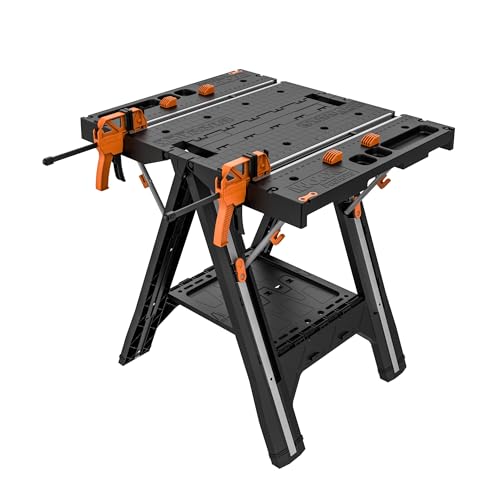
WORX Portable Folding Workbench, 2-in-1 Pegasus Table & Sawhorse, WX051
Check Amazon offerThink about the two pieces you will create
Before positioning the rail, identify the retained part and the offcut. Both need a planned destination as the cut finishes. A large unsupported offcut can drop, while a sagging panel can close the kerf and pinch the blade. Arrange supports to avoid those changes using the manufacturer's guidance. Do not judge stability only by pressing on the uncut sheet; imagine how each piece behaves once its last connection is severed. Internal openings need the same consideration for their center waste.
Keep the blade clear of hidden hardware
Check beneath the full cut line for bench dogs, clamp bars, screws and support members. The required clearance depends on the blade setting and the actual cutting operation. A sacrificial layer is useful only when it sits on a stable base and the permitted blade projection will not reach something unintended. Mark or reposition hidden hardware where appropriate. Do not assume a familiar bench remains clear after another project has added a fixture or a fastener below the surface.
Set a comfortable route for the operator
You need stable footing and access to the handles throughout the cut. A very large panel on a small table may force an awkward reach even if it does not visibly wobble. Rotate or reposition the work so the saw can be operated as instructed without leaning across the blade path. Consider hose and cord travel at the same time. On long cuts, the middle and far end often reveal problems that are invisible when standing at the starting edge.
Clamp without distorting the arrangement
Use workholding suitable for the rail and support system, and keep clamp hardware outside the saw and blade travel. Check whether tightening a clamp shifts the rail or bows unsupported material. A clamp is not automatically beneficial if it changes the surface the saw is following. Recheck the cut reference after securing the setup. For narrow work, use the manufacturer's approved support method rather than trying to hold a wide rail level with one hand during the cut.
Vertical cutting is not an assumed feature
The ability to place a rail on a surface does not prove that the saw is approved for vertical or overhead operation. Gravity changes how the saw, rail and offcut behave. Do not adapt a horizontal panel workflow to an installed wall based only on a video or an accessory's appearance. Require explicit instructions for the exact tool and system, plus a known safe cutting area. Where that support is absent, remove the work to a suitable horizontal setup or choose an appropriate alternative method.
Reassess after each major cut
A full sheet becomes a smaller panel, and later cuts may leave little material under the rail. Update support and clamping as the geometry changes. Keep the working area clear of loose offcuts before the next operation, after the blade has stopped. A dedicated cutting table can make this process easier but does not eliminate judgment about a particular piece. The useful question is always whether this arrangement controls this work through the complete cut with the required clearances and access.
Questions about How to Support Work for Track-Saw Cutting
Can I cut a sheet on two sawhorses?
Only if the complete arrangement provides stable, appropriate support and avoids blade pinching or contact with the supports. The number of sawhorses alone does not establish a suitable setup.
Can I use a track saw vertically?
Do not assume that is permitted. Use only an operation explicitly supported by the exact saw and guide-system instructions, with suitable workholding and a known clear cutting area.
Does the offcut need support too?
Plan its behavior as the cut finishes. An uncontrolled piece can drop or pinch the blade; follow the saw manual's support guidance rather than leaving the waste to chance.

