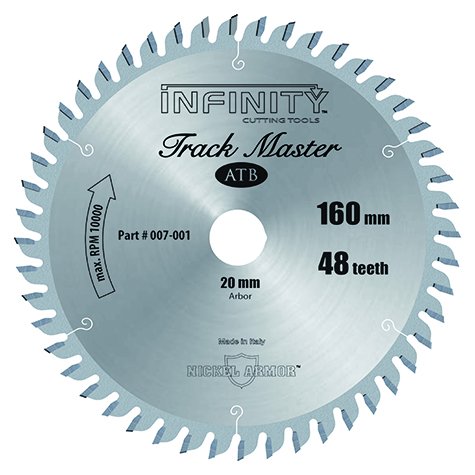
Track Saw Blades & Accessories
Track Saw Blades for Plywood, Veneer and Laminate
The best blade for a plywood project is an approved blade whose geometry suits the panel and desired finish. Start with the saw’s fit requirements, then distinguish ordinary plywood, delicate veneer and laminate. A larger tooth count is not a complete selection rule, and a clean cut depends on the rail and support as well as the teeth.
As an Amazon Associate I earn from qualifying purchases. How affiliate links work.
Inspect the relevant offer

Milwaukee 48 Teeth Fine Finish Track Saw Blade, 165 mm Blade
Check Amazon offerName the panel before choosing the blade
Plywood varies in core construction, face veneer and adhesive system. A rough shop fixture and a visible cabinet side have different acceptance standards even when both use three-quarter-inch sheets. Laminate-covered panels add another surface to evaluate. Read the blade maker’s application description and the saw’s permitted materials. Avoid treating every sheet good as an identical woodworking cut. If the intended material is not listed, ask the manufacturer rather than assuming a fine-tooth wood blade is appropriate.
Match the saw before comparing tooth counts
Confirm diameter, arbor, kerf, plate thickness and speed requirements. The right material label does not overcome a mechanical mismatch. Keep the exact model suffix in the shopping list, especially when a saw family has changed blade specifications over time. Makita’s B-07353 is a documented 48-tooth blade example associated with the SP6000J application. That specific relationship is more useful than the broad statement that every 48-tooth blade fits every plunge saw.
Tooth count is a clue rather than a verdict
More teeth can change how the blade balances edge finish and chip removal, but tooth geometry and the intended application remain important. Compare blades within the manufacturer’s approved choices instead of choosing the highest number in a search result. A blade designed for laminate may use a different geometry from one intended mainly for wood. Do not borrow a blade from another saw simply because its tooth count sounds suitable. Read the markings on the actual blade, not only the package headline.
Support the face you want to preserve
The rail splinter strip helps provide a reference and edge support on its side of the cut, but it does not cure every source of chipping. Keep the panel stable and the offcut supported according to the operating instructions. Inspect the strip for gaps or wear before blaming the blade. If a saw offers a documented scoring function, follow that procedure rather than inventing a reverse-cut technique. An operation shown for a different machine should not be transferred automatically.
Use a representative test to choose the setup
Cut scrap from the same panel type and inspect both faces and the edge. A substitute material can hide a problem that only appears in the final veneer or laminate. Check whether the damage is localized at the start, finish or rail joint, which may point to support or alignment rather than blade choice. Change one factor at a time. Keep notes on the approved blade and successful settings so repeated projects do not require starting the evaluation from memory.
Replace or service a blade for condition, not calendar age
Resin buildup, damaged teeth and loss of cutting performance are reasons to inspect the blade. Follow the manufacturer’s cleaning guidance and use qualified sharpening where the blade is serviceable. Do not continue forcing a blade because a premium brand should supposedly last longer. If a known suitable setup begins producing poorer edges, inspect the blade, rail strips and alignment together. Buying a new blade without finding the cause can leave the same defect in the next sheet.
Questions about Track Saw Blades for Plywood, Veneer and Laminate
How many teeth should a track saw blade have for plywood?
Choose from blades approved for your saw and specified for the panel. Tooth count is only one factor; grind, kerf and material application also matter. There is no single tooth count for every saw and sheet.
Can one blade cut both plywood and laminate?
Only when the blade maker lists both applications and the saw supports the material. For demanding visible edges, test the actual panel rather than assuming a general-purpose label guarantees the finish.
Will a premium blade eliminate all tearout?
No. Support, rail alignment, splinter-strip condition and operation also affect the edge. Use a suitable test piece to separate blade-related issues from setup problems.