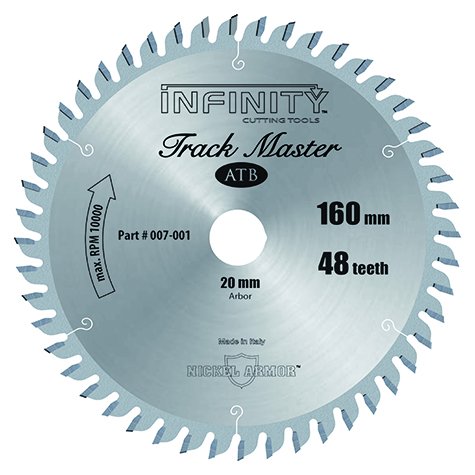
Track Saw Blades & Accessories
Track Saw Blade Size, Arbor and Kerf: Fit Checklist
A track saw blade must match more than diameter. Arbor size, cutting width, plate thickness, rated speed and the saw’s blade requirements all matter. A blade checker can flag an obvious mismatch, but it should never declare a blade safe solely because two dimensions match.
As an Amazon Associate I earn from qualifying purchases. How affiliate links work.
Inspect the relevant offer

Milwaukee 48 Teeth Fine Finish Track Saw Blade, 165 mm Blade
Check Amazon offerRead the complete blade requirement
Start with the exact saw model and its current manual. Record blade diameter, arbor diameter, permitted cutting width or kerf, any plate-thickness requirement and the required speed rating. Include the intended material and cutting mode. A nominal six-and-a-half-inch label is not a substitute for the specified metric dimensions. If the blade package omits a critical value, obtain it from the blade manufacturer. A missing specification should remain unknown rather than being silently treated as a pass.
Kerf and plate thickness describe different things
Kerf is the width removed by the cutting teeth; plate thickness describes the steel body behind them. On a saw with a riving knife, those dimensions must maintain the relationship specified in the manual. The Milwaukee 2831-20 instructions require the blade body to be thinner than the knife and the cutting width to be wider. This explains why matching diameter and arbor alone is insufficient. Do not remove or alter a riving knife to accommodate an unsuitable blade.
Festool generations show why model names matter
Festool’s blade guidance distinguishes newer 1.8-millimeter cutting-width blades from the 2.2-millimeter system used by older TS 55 R and TSC 55 saws. It specifically rejects treating those widths as interchangeable across all generations. Read the full suffix on the tool, not merely TS 55. A blade found under a broad Festool search can belong to a different generation. Keep the manufacturer’s actual compatibility statement alongside dimensional data when evaluating a replacement.
Teeth and material come after mechanical fit
Once a blade meets the saw’s requirements, choose the maker’s intended application: wood ripping, fine crosscutting, laminate or another permitted material. Tooth count alone does not establish the correct grind, hook angle or suitability. A high tooth count can be the wrong choice for a particular task, and a material-specific blade does not authorize that material in an incompatible saw. Both the machine and the blade instructions must support the application. Keep specialty operations separate from general woodworking recommendations.
What a responsible blade checker should display
A useful checker reports mismatched known values and lists unresolved requirements. It can say that the recorded diameter and arbor match, while still requiring confirmation of kerf, plate thickness, speed and application. It should not round 160 millimeters into 165 or treat a missing field as zero. A comparison against user-entered specifications is a screening aid, not manufacturer approval. Keep a direct source link available so the final choice can be verified before installation.
After changing blades, recheck the cutting reference
Disconnect power and follow the exact blade-change procedure, using the specified hardware and orientation. Never substitute an improvised arbor reducer or mounting arrangement. After installation, check the relationship between the new blade and rail splinter strip according to the system instructions. A different approved blade may require a renewed test cut before the strip can be trusted as the cut-line reference. Inspect the result on scrap that represents the project material before cutting parts to finished dimensions.
Questions about Track Saw Blade Size, Arbor and Kerf: Fit Checklist
Are all 6-1/2-inch track saw blades interchangeable?
No. Verify the exact diameter, arbor, kerf, plate thickness, speed rating and application required by the saw. Similar nominal size does not establish a safe mechanical match.
Can I put a thinner-kerf blade on my track saw?
Only where the manufacturer supports it for that exact model. Riving-knife geometry and other system requirements can make a thinner blade unsuitable even when it mounts on the arbor.
Does matching a 20-millimeter arbor prove fit?
No. Arbor size is one requirement among several. A checker should show any remaining unknowns and mismatches rather than convert a partial dimensional match into full compatibility.