Track Saw Blades & Accessories
Track Saw Parallel Guides: Repeat Widths Accurately
Parallel guides help position a track saw rail a repeated distance from a reference edge. Their value is reduced measuring and marking when several panels need the same width. They are not a substitute for a straight reference, and their supported width range and mounting method must match the rail and work.
As an Amazon Associate I earn from qualifying purchases. How affiliate links work.
Inspect the relevant offer
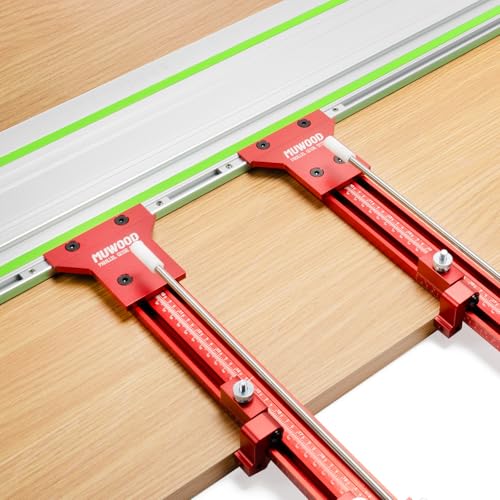
MUWOOD Track Saw Parallel Guide System for Woodworking Repeatable Rip Cuts for Track Saw Guide Rail Compatible with Festool, Makita, Milwaukee
Check Amazon offerUnderstand what the stops actually reference
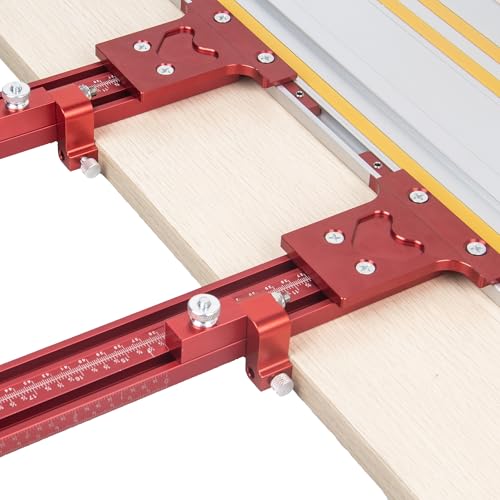
Most parallel-guide arrangements use adjustable stops that contact an existing material edge. The rail then follows the chosen offset. If that edge is curved or damaged, the resulting setup can carry the error forward. Establish a reliable reference and mark it before cutting a batch. Keep both guide contacts seated as intended and check that the panel is supported. The measuring scale is useful only after the relationship between the stops, rail and actual cut line has been established.
Match the rail and accessory generation
Guide systems may attach directly to a rail or through another accessory such as a square. Confirm the complete mounting chain, including any adapter or connector required. A guide sold for one rail family should not be assumed to fit another because both rails accept a familiar clamp. Read the manufacturer’s range and exclusions for the selected model. If an accessory has changed generation, verify whether its older connectors remain supported rather than assembling parts based on brand continuity alone.
Calibrate against the actual cutting setup
Follow the maker’s calibration procedure with the intended rail and approved blade. Verify a test piece at both ends before producing a batch. If the rail splinter strip changes or the saw’s blade offset changes, check the calibration again. Do not compensate for a tapered test cut by setting two different widths without understanding the cause. Inspect the reference edge, guide seating and rail alignment first. A reliable setting should produce repeatability without depending on a hidden correction for another fault.
Check the narrow-rip method separately
A guide’s general width range does not necessarily include very narrow strips. Festool’s FS-PA and its FS-PA-VL extension illustrate separate components for different width tasks. The extension is not a standalone replacement for the main guide. Other systems have their own minimums and support methods. Follow the documented narrow-work arrangement and keep hands outside the cutting path. A small numerical setting on a scale is not proof that the material and offcut can be supported appropriately.
Batch cuts without losing the reference
Label parts and keep the established edge consistent while moving through the cut list. Recheck the setting after the guide is bumped or the rail is moved awkwardly. Support finished pieces somewhere clear of the next operation so they are not used as makeshift props. If material thickness or the support arrangement changes, confirm that the stops still contact correctly. A repeat-width accessory saves layout time only when its physical reference remains the same across the batch.
Choose guides when width repetition is the bottleneck
For one or two panels, marking both ends may be faster than installing and calibrating a complete guide system. Repeated cabinet parts or shelving can justify the setup time. Compare the useful width range, mounting speed, storage and included components instead of selecting solely by maximum advertised capacity. Consider whether the guides also require a dedicated rail or square in your preferred configuration. Include those parts in the total so the upgrade’s cost reflects a working system.
Questions about Track Saw Parallel Guides: Repeat Widths Accurately
Do parallel guides make a panel square?
They primarily establish a repeated offset from an existing edge. Squareness also depends on the reference geometry and crosscut setup. A rail square and parallel guides address different parts of panel preparation.
Can parallel guides cut very narrow strips?
Only within the system’s documented range and support arrangement. Some require a separate extension or special setup; do not infer safe narrow-work capacity from the scale alone.
Must I recalibrate after changing blades?
Check the manufacturer’s guidance and verify the cut-line relationship after a change. If the blade or splinter-strip reference shifts, a previous scale setting may no longer produce the same finished width.