Track Saw Rails & Compatibility
How Long Should a Track Saw Rail Be? Plan the Full Cut
A track saw rail should cover the cut plus the front and rear travel the saw requires for the intended operation. Those allowances are model-dependent; rail length does not equal guaranteed cutting capacity. Use the rail-length planner as arithmetic support, then verify the physical setup against the saw and connector instructions.
As an Amazon Associate I earn from qualifying purchases. How affiliate links work.
Inspect the relevant offer
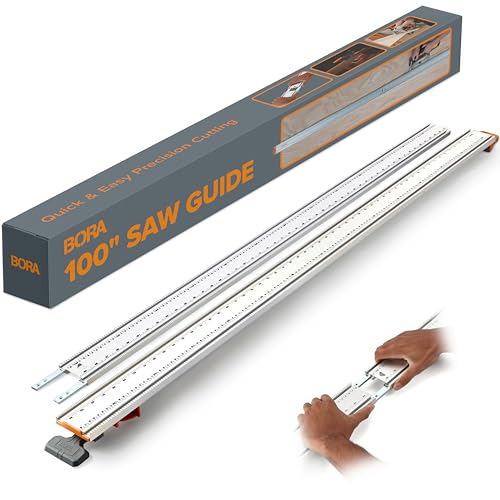
BORA NGX Circular Saw Guide Rail, 100" Straight Edge Clamp - Track Saw Rail
Check Amazon offerUse three measurements in the calculation
Required rail length equals cut length plus front allowance plus rear allowance. Keep all three in the same unit. For an illustrative 96-inch cut with user-selected seven-inch allowances at both ends, the arithmetic is 110 inches. That example is not a universal recommendation for seven inches of overhang. Obtain the actual allowances from the manufacturer’s instructions for the saw, rail and cutting mode. If they are unknown, the calculation is incomplete rather than permission to use zero.
Understand what the planner cannot inspect
A length calculation cannot see whether the base is supported, whether an anti-tip feature engages or whether the rail is straight. It cannot establish that two sections or their connectors are compatible. A result showing sufficient nominal length is therefore only one planning check. Confirm the setup physically with the tool disconnected and follow the operating instructions. Do not round a marginal result upward to make a short rail appear adequate; preserve the actual units and leave unresolved requirements visible.
A single rail minimizes one source of setup work
One continuous extrusion removes the task of aligning a mid-cut joint. That can be valuable when many long cuts happen at a fixed station. The tradeoff is handling: long rails need safe transport and protected storage, and they can be awkward to place alone in a restricted room. Compare the longest routine cut with the station’s layout. Buying a very long rail for a rare project may create daily inconvenience without improving the cuts you make most often.
Joined sections need more than enough total inches
Use connectors specified for the exact rail arrangement and follow their alignment sequence. Festool’s FSV/2, for example, is a two-piece connector product with an intended installation order; that design should not be generalized to unrelated rails. Support the sections during assembly and inspect the guiding path at the seam. A connector bar is not a repair for bent metal. Recheck after transport or repositioning because a previous successful assembly does not establish the current setup.
Plan crosscuts separately from long rips
A rail suited to a long sheet rip can feel cumbersome on a short cabinet panel. Conversely, a compact guide convenient for short cuts may not cover a panel’s full width plus travel allowances. Consider whether two useful individual sections can also form a documented long configuration. Include connector cost and assembly time in that comparison. Keep any dedicated splinter-strip calibration in mind if different saws share the sections. Similar total length does not make two systems equally convenient for every sequence of cuts.
Verify the plan before ordering
Write the material dimensions, cut direction, saw model, rail lengths and connector part numbers together. Note where the work and offcut will be supported and where the hose exits. If the planned rail extends into a wall, doorway or stacked material, revise the station rather than reducing a required allowance. This check catches practical constraints that a shopping cart cannot. Purchase only after both the length arithmetic and the documented system requirements have been satisfied.
Questions about How Long Should a Track Saw Rail Be? Plan the Full Cut
Is a 55-inch rail enough to crosscut a 48-inch sheet?
It depends on the saw’s required entry and exit travel. Subtract the actual allowances from the rail length and verify the supported setup. Do not assume every saw can use the same margin.
Can I add the lengths of two rails?
You can add physical lengths for planning, but usable length still depends on the approved connection and travel requirements. The sum does not establish compatibility or correct alignment.
Does a longer rail make cuts more accurate?
Length by itself does not guarantee accuracy. It must be sufficient for the cut, straight, supported and correctly aligned. A longer rail may remove a joint but also be harder to handle without damage.


