Track Saw Blades & Accessories
Track Saw Rail Connectors: Join Without an Alignment Step
Rail connectors should hold compatible sections in a straight, stable relationship. They are not universal bars and cannot repair a bent rail. Choose the set specified for the exact rails, follow its installation sequence and inspect the joint before sending the saw across it.
As an Amazon Associate I earn from qualifying purchases. How affiliate links work.
Inspect the relevant offer
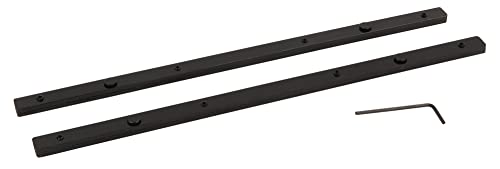
These are Festool FSV/2 and Makita 198885-7 connector offers, not complete rails. Confirm the connector instructions and exact rail extrusion; a brand-family label alone does not establish fit.
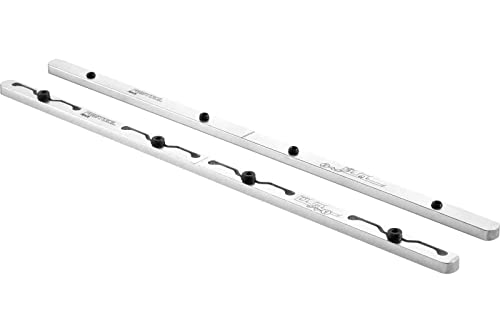
Festool 577039 Guide Rail Connector Set FSV/2
Check Amazon offerIdentify the complete connector set
Some systems use more than one connector, and the pieces may have different roles or orientations. Festool’s FSV/2 is a documented two-connector set with installation markings. Other systems must be evaluated on their own instructions rather than assumed to use the same sequence. Confirm what the package includes: bars, screws, wrench and any required additional hardware. A low-cost listing for one replacement bar is not necessarily a complete joining kit.
Fit is about clamping surfaces as well as slot size
A connector sliding into a channel does not establish that it locks in the intended way or keeps the guide surfaces aligned. Read the rail and connector maker’s compatibility statements. Mixing brands needs explicit support for the actual combination. Do not file a bar, substitute random screws or tighten an incorrect component to force a fit. An apparently secure joint can still place a lateral step in the saw’s path or distort a thin part of the extrusion.
Support the rails while aligning them
Assemble on a stable surface that lets you inspect the sections without using their weight to pull the joint crooked. Follow the specified tightening sequence and check that the guiding surfaces remain aligned. The joint should not be used to bridge unsupported loads beyond the system’s instructions. If a rail end is damaged, solve that problem before joining it. Tightening a connector harder is not an acceptable way to straighten impact damage or hide a burr.
Inspect more than the splinter-strip seam
The visible edge can look continuous while the actual guiding rib has a step. Inspect the working guide surfaces and the base’s intended travel with power disconnected. Check for interference from protruding screws or incorrectly installed hardware. Keep hands clear of sharp rail ends and blade components. If travel catches at the seam, resolve the cause before cutting. A powered saw should not be used to test whether a questionable mechanical joint will smooth itself out.
Recheck after movement and between critical setups
Long joined rails are awkward to carry and can be stressed while being placed on a panel. Recheck alignment after transport, assembly changes or an accidental knock. For repeated precision work, build that brief inspection into the setup routine. A long single rail can remove the joining step when storage and transport allow it. Joined sections remain useful, but their convenience depends on consistent inspection rather than assuming one successful connection lasts indefinitely.
Store the hardware so it stays identifiable
Keep connector sets together and labeled for the rail family. Protect screw threads and bearing surfaces from loose debris and impacts. Replace missing or damaged hardware with the specified parts. If the shop has multiple systems, do not combine similar-looking bars in one unlabeled container. A small dedicated pouch can prevent a hurried substitution at the job site. Include connector condition when evaluating a used rail bundle; incomplete hardware changes both the price and the time needed to make it usable.
Keep the correct wrench with the set so adjustments do not invite substitute tools that damage the fasteners.
Questions about Track Saw Rail Connectors: Join Without an Alignment Step
Are track saw rail connectors universal?
No. Match the connector set to the exact rails and any documented cross-brand combination. Slot fit alone does not establish correct clamping or alignment.
Can connectors straighten a bent rail?
They should not be used as a repair for structural damage. Inspect the rail and resolve deformation before returning the system to cutting service.
Why does the saw catch at a rail joint?
Possible causes include misalignment, damaged ends, debris or incorrectly installed hardware. Disconnect power and inspect the assembly; do not force the saw through an unresolved obstruction.