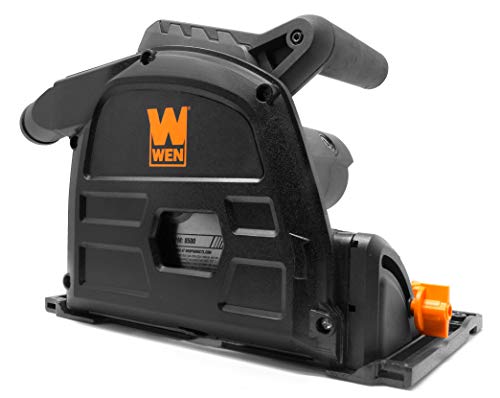
Track Saw Troubleshooting
Why Is My Track-Saw Cutting Depth Wrong?
If a track saw does not cut through, or cuts deeper than expected, start with the relationship among stock thickness, rail height and the selected stop. The depth scale is part of a specific tool design. Do not solve the problem by immediately plunging to maximum depth or copying another saw's numerical setting.
As an Amazon Associate I earn from qualifying purchases. How affiliate links work.
Inspect the relevant offer

Makita SP6000J 6-1/2-Inch Plunge Circular Saw
Check Amazon offerMeasure the work instead of its label
Check the actual thickness along the cut, including any bonded surface or uneven area. Nominal plywood and lumber descriptions are not precision measurements. If the work sits on a sacrificial layer, identify that layer separately from the component you intend to cut. Write down the desired result: a complete through-cut or a permitted stopped-depth operation. Without that distinction, it is easy to judge a correct through-cut against an imagined groove depth or overlook a thicker spot in rough material.
Find the correct rail reference
Some tools provide separate on-rail and off-rail indicators; others describe an adjustment method in the manual. Confirm which reference you are reading for the setup in use. The rail raises the saw above the material, so the blade's projection below the base is not automatically its penetration into the work. Do not estimate a universal rail allowance from a different brand. Use the actual instructions, especially when an adapter system adds another layer between the saw and the panel.
Check for a scoring or plunge limit
A shallow-cut stop can remain engaged after a previous operation. Verify the selected mode and the position of the depth stop with power disconnected. Follow the model's adjustment sequence and ensure the required lock is secure. If a control does not move or hold as described, stop and consult service guidance rather than forcing it. A mechanical setting issue can resemble inadequate cutting capacity even when the saw would normally handle the material.
Account for the bevel and blade specification
A tilted blade generally has a different usable depth from a square cut. Compare the documented on-rail capacity at the intended angle. Also verify that the installed blade meets the saw's specification; a different diameter should not be used as an improvised depth adjustment. A blade that physically fits can still be unsuitable. If the job exceeds the permitted capacity, choose an appropriate tool or process rather than attempting to gain extra reach by removing required components.
Inspect what remains after the cut
An uncut layer across the entire length suggests a different cause from a small connection at one point. The latter may involve uneven stock, support movement or incomplete plunge travel. Examine the work after the blade stops and power is disconnected, without reaching into an unsafe position. Note whether the saw remained properly seated on the rail. A chip under the base or an unstable support can change the relationship you thought was fixed by the depth scale.
Verify with a controlled sample
Use the manual's method to check or set depth, then make a trial in suitable scrap with known clearance beneath it. For a precision recess, measure the resulting depth only if the saw is approved for that operation; a track saw is not automatically a substitute for every grooving tool. Keep any calibration within the manufacturer's user adjustments. If depth changes during a cut despite a correct locked setup, stop using the saw and seek qualified service rather than treating the behavior as a normal tolerance.
Questions about Why Is My Track-Saw Cutting Depth Wrong
Why does my saw cut shallower on the track?
The rail raises the base. Use the model's correct on-rail indication or setting method rather than applying an off-rail depth reading unchanged.
Should I set maximum depth to guarantee a through-cut?
No. Set depth according to the actual material and manual, with the required clearance. Excess projection can contact supports and is not a substitute for diagnosing the setting.
Can I use a smaller blade to make shallow cuts?
Use only blades approved for the exact saw. Adjust depth through the intended controls rather than changing blade diameter as an improvised workaround.