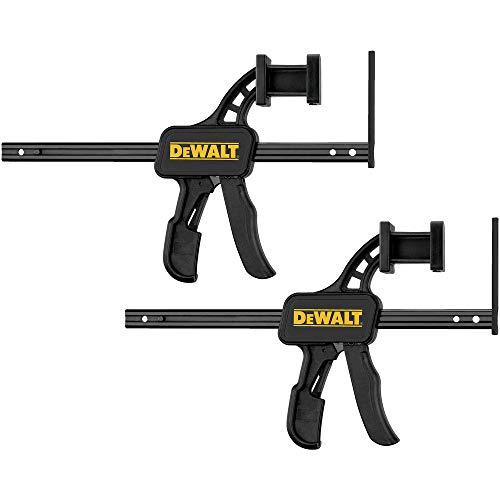
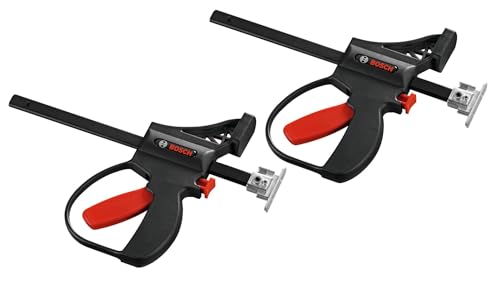
Track Saw Blades & Accessories
Track Saw Clamps: Fit, Capacity and Where They Help
A track saw clamp must fit the rail’s underside channel and reach the work without obstructing the saw. Nominal clamping force is less useful than the right arm geometry, usable capacity and practical access below the panel. Select the exact rail-compatible clamp before comparing screw and quick-action styles.
As an Amazon Associate I earn from qualifying purchases. How affiliate links work.
Inspect the relevant offer

Makita 199826-6 Quick Release Clamp Set for Guide Rail
Check Amazon offerCheck the fixed arm against the rail channel
BESSEY describes its GTR track clamp around a specific groove geometry. That is the kind of dimensional information a useful listing should provide. A clamp can be excellent for a workbench and still be wrong for a saw rail. Confirm the clamp maker’s supported rail list and any model limitations. Do not grind or force the fixed arm to fit a narrow channel. The correct fit must preserve the rail and allow the clamp to seat as intended.
Measure capacity in the actual support arrangement
The opening has to reach from the rail channel around the material or support structure you intend to clamp. A thick sacrificial layer can consume more capacity than expected. Check throat reach as well as maximum opening, and leave room for the handle beneath the work. A clamp that fits on a loose panel may be inaccessible when that panel is on the chosen table. Plan the whole arrangement before ordering a short, compact pair solely because it stores neatly.
Screw and quick-action styles solve different handling needs
A screw clamp offers controlled tightening but may be slower to reposition. A quick-action mechanism can speed repeated placement when its range and clearance suit the setup. Choose the mechanism around how often the rail moves and whether you can reach it comfortably. Do not assume that the fastest handle is automatically better for every cut. Both styles require correct seating, and neither should be used to distort a rail into contact with a badly supported panel.
Clamping the rail is not the same as supporting the offcut
A secure guide controls its own position but does not prevent a large piece from sagging or falling. Support the material and offcut in accordance with the saw’s instructions. Keep clamps, bench hardware and other fixtures clear of the blade path, including the path below the material. Bevel cuts can change clearances. With power disconnected, inspect the travel before starting. Reposition the work if you cannot keep the hardware clear without compromising support.
Follow the system’s actual requirement for each operation
Some guide systems advertise use without separate rail clamps in certain circumstances, while other operations call for additional restraint. Kreg’s Accu-Cut information, for example, describes optional track clamps for its own setup. That statement should not be transferred to every plunge saw or cutting mode. Read the instructions for your rail, saw and material. Dusty or slippery surfaces and unusual angles can change the practical setup, but the manufacturer’s requirements remain the starting point rather than a generic rule from another system.
Keep a small compatible set ready
Store clamps with the rail family they fit and inspect the pads, arm and locking mechanism before use. Replace damaged parts through the manufacturer’s supported route. If the shop has several rail systems, label the clamp storage so a similar-looking model is not substituted under time pressure. Buy additional capacity when a real project needs it. A dependable pair that fits the existing work is more useful than a large mixed bundle whose parts require repeated checking or improvised installation.
Questions about Track Saw Clamps: Fit, Capacity and Where They Help
Do track saws always need rail clamps?
Follow the instructions for the specific saw, rail and operation. Some guide systems describe clamp-free use under stated conditions, but that does not establish a universal rule for every setup.
Can ordinary bar clamps hold a track saw rail?
Only if the intended arrangement is supported and leaves every part clear of the saw and blade. Rail-specific clamps are shaped for compatible channels; do not assume any bar clamp can substitute safely.
Does more clamping force improve accuracy?
Correct seating and support matter more than maximum force. Excessive tightening is not a method for correcting a bent rail or uneven work surface.