Track Saw Blades & Accessories
Track Saw Rail Hinges: MFT Fit and Repeat-Cut Setup
A rail hinge lets a guide lift out of the way and return to a cutting position on a compatible worktable. It can speed repeated panel crosscuts, but the hinge is only one part of the reference system. The table, front support, rail and work stops must all fit and align together.
As an Amazon Associate I earn from qualifying purchases. How affiliate links work.
Inspect the relevant offer
The linked listing identifies a rear hinge assembly only, not a complete front-and-rear hinge system or workbench. Exact rail, table and mounting fit have not been independently confirmed; check those dimensions and the complete parts list before ordering.
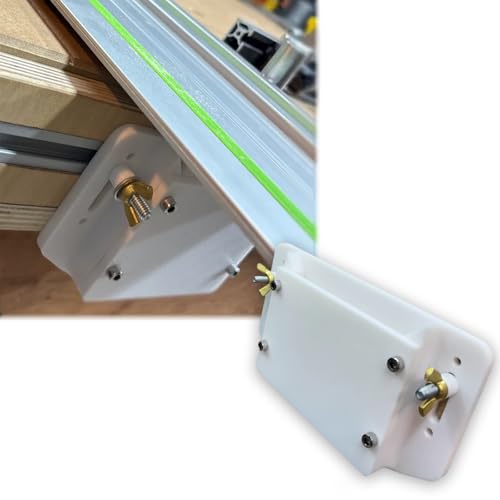
Track Hinges for Track saws/MFT Tables, Hinge Brackets for Woodworking, Precision Angle Guides for Cutting Tables(Rear Hinge Assembly only)
Check Amazon offerA hinge needs a matching support arrangement
Do not evaluate a rear pivot alone. A workable system also needs the intended front support or landing reference and a way to hold the rail at the required height. Check the rail profile, table mounting interface and supported material range. A generic hinge listing may omit one of those components. If the product relies on existing table hardware, include that requirement in the buying decision. A small accessory kit is not necessarily a complete conversion for an unrelated bench.
Distinguish an upgrade from a complete hinge kit
TSO’s MFT aligned guide-rail support upgrade reuses components of the original Festool hinge arrangement. That makes it an upgrade for a specific starting system, not a universal standalone hinge. Read the included and reused parts carefully. Other products can have different requirements, especially when made for a drilled worktop or a specific extrusion. Match the actual hardware chain before purchasing. Similar-looking brackets do not prove that height adjustment, locking and return alignment will work on your table.
Set the material reference before judging the hinge
The guide’s cutting line must have the intended relationship to the table’s fence or other reference. Follow the system maker’s alignment method and verify on a suitable test piece. A hinge that returns consistently can still return to the wrong angle if the fence is misaligned. Keep chips away from reference surfaces and check that the work is seated as intended. The goal is a complete repeatable geometry, not simply a rail that swings smoothly.
Check height and clearance for the actual panel
Changing material thickness can require adjusting the support arrangement. Follow the documented method so the rail remains supported and correctly positioned. Check the blade path below the work and keep hinges, stops, clamps and table structure clear. A bevel cut changes clearances and should not inherit approval from a previous square cut. With power disconnected, inspect the full saw travel after the rail is lowered. If the setup binds or a support does not engage, resolve it before operating.
Treat printed and homemade hardware as unverified unless documented
A downloadable model or attractive workshop video does not establish load capacity, material durability or compatibility with your table and rail. Avoid making definitive safety or precision claims for an untested print. If evaluating a commercial hinge, look for clear instructions, supported interfaces and replacement-part information. Do not depend on an unidentified printed latch to compensate for missing original hardware. The more an accessory controls the cutting reference, the more important its documented fit and installation become.
Choose a hinge when repeated loading justifies it
A hinged rail is useful when many similarly supported parts need crosscuts at a stationary setup. It may be unnecessary if most work happens on full sheets in changing locations. Compare the time saved lifting and repositioning the rail with the cost and space of the complete table arrangement. Store the saw separately when the system requires it and protect the rail while the table is moved or folded. Recheck alignment after transport rather than assuming the hinge preserves calibration under every condition.
Questions about Track Saw Rail Hinges: MFT Fit and Repeat-Cut Setup
Will any track saw hinge fit an MFT-style table?
No. Verify the exact table interface, rail profile, front support and height range. The phrase MFT-style is not a complete dimensional or compatibility specification.
Does a hinge automatically make crosscuts square?
No. It must return the rail to an aligned reference relative to the fence and work. Check the complete system with the manufacturer’s setup method and an appropriate test cut.
Is the TSO MFT support upgrade a standalone hinge?
Its product description says it reuses parts of the original Festool hinge bracket arrangement. Confirm the required starting components before treating it as a complete kit.