Track Saw Blades & Accessories
Track Saw Dust Hoses and Adapters: Fit Without Snagging
A track saw dust connection needs a secure tool-end fit, a suitable extractor and a hose route that follows the entire cut. Matching a nominal hose diameter is only part of that setup. Before buying reducers or extensions, inspect the actual connection type and the movement required at the saw.
As an Amazon Associate I earn from qualifying purchases. How affiliate links work.
Inspect the relevant offer
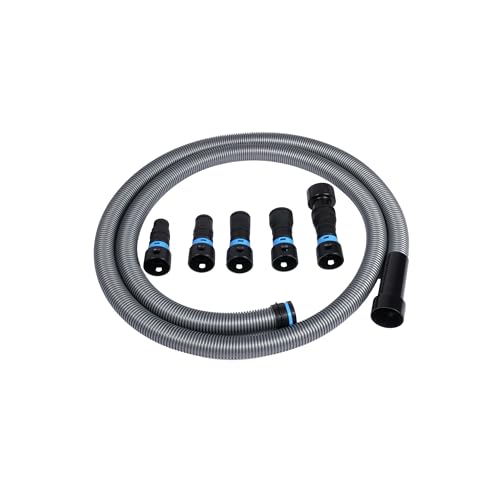
Cen-Tec Systems 94698 Quick Click 10 Ft. Hose for Home and Shop Vacuums with Expanded Multi-Brand Power Tool Adapter Set for Dust Collection
Check Amazon offerStart with the saw’s documented connection
Use the exact model’s port specification and supported hose information. Milwaukee’s 2831-20 page, for example, names compatibility with a particular nominal vacuum-hose size. That does not make every hose carrying a similar label identical at its cuff. Inner and outer diameters, taper and locking features can differ. Identify which surface the adapter must fit and confirm the manufacturer’s intended connection. A retailer’s broad phrase fits most vacuums is not a substitute for the two actual interfaces.
The extractor is a separate equipment decision
A hose adapter joins components; it does not establish that the extractor is appropriate for the material and task. Follow the saw, extractor and material instructions for filtration, collection and operating requirements. Check bag and filter condition and use the intended setup. Do not describe a generic shop vacuum as equivalent to every dust extractor. If a material creates special dust requirements, resolve those requirements independently rather than assuming the rail saw’s enclosed blade area handles them automatically.
Keep adapters short and mechanically sensible
A stack of rigid reducers can add bulk and leverage to the saw port. Prefer a documented connection that remains secure while the saw moves through the cut. Verify that the cuff does not interfere with plunge controls, bevel adjustment or the operator’s grip. If the connection repeatedly falls off, identify the mismatch rather than relying on layers of improvised tape. A correct-fitting flexible arrangement is generally easier to route than a long rigid assembly projecting into nearby objects.
Plan the full hose path before cutting
Lay out the panel and rail, then arrange enough hose for the entire operation without tight bends or snag points. With power disconnected, check the saw’s travel and the hose’s approach to the rail end. A hose that pulls sideways can disturb positioning or demand an awkward grip. Move the extractor or use an approved routing accessory when needed. Do not wait until the saw is in material to discover the hose is caught beneath a table leg or stored panel.
Cordless saws still need dust-system planning
Removing the saw’s power cord can make movement simpler, but the extraction hose remains. A corded extractor still requires an outlet, while a cordless one creates a second battery and runtime consideration. Coordinate startup and charging with the actual equipment. Do not assume a wireless control feature exists merely because both tools are cordless. Confirm any automatic-start compatibility explicitly. The useful comparison is how the complete system moves and operates, not whether the saw alone has a battery.
Inspect the connection when performance changes
Reduced collection can come from an obstruction, damaged hose, loose cuff or extractor maintenance issue. Stop and inspect according to the equipment instructions rather than increasing cutting speed to get through the task. Keep hoses away from the blade path and avoid using the rail as a storage hook for heavy fittings. Record the successful adapter and cuff combination so replacing a hose later does not restart the same fit problem. Label adapters when several similar systems share the shop.
Questions about Track Saw Dust Hoses and Adapters: Fit Without Snagging
Can I use any vacuum hose on a track saw?
Only if the connection and extractor setup meet the equipment’s requirements. Nominal diameter alone does not prove cuff fit, locking compatibility or suitability for the dust involved.
Does a hose adapter improve dust extraction?
It can provide the correct connection, but it does not upgrade the extractor’s capabilities. Filtration, hose condition, restrictions and the manufacturer’s requirements still matter.
Why does my hose pull the rail during a cut?
The route may be too tight or caught on something. Stop safely and rearrange the setup. Check the complete travel with power disconnected before restarting rather than compensating with an awkward sideways grip.


